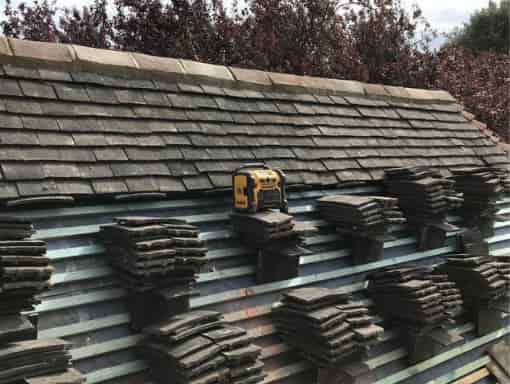
Roof defects do not always begin as major problems. A slipped tile, small flashing defect, damaged section of pointing or localised weakness can initially affect only a limited part of the roof. The difficulty is that roofing components work together, meaning a relatively minor defect can sometimes allow water or weather exposure to affect surrounding materials if it remains unresolved.
For property owners in Dover, Kent, arranging timely roof repairs can help prevent localised deterioration from developing into a wider roofing problem. Addressing the cause while damage remains confined may protect surrounding tiles, underlay, battens, roof timbers and internal areas from unnecessary exposure.
However, effective roof repair involves more than treating the first visible symptom. The source of the problem needs to be identified, the surrounding roof checked and an appropriate repair carried out. This cause-based approach is particularly important when dealing with leaks because the point where water becomes visible inside a property may not be directly beneath the external defect.
How Can Early Roof Repairs Help Prevent Further Deterioration?
Timely roof repairs can prevent wider problems by addressing damaged or displaced roofing components before prolonged exposure allows deterioration to spread.
The exact consequences of delaying a repair depend on the type of roof, location of the defect and condition of the surrounding materials. Some minor defects remain localised for a period, while others can allow water to travel into less visible parts of the roof.
Early professional assessment helps establish what has happened and whether nearby areas have also been affected.
Small Roofing Defects Can Have Wider Consequences
A roof is made up of numerous interconnected components.
Tiles or slates provide the main external covering, but the complete system can also include underlay, battens, flashing, ridge details, valleys, gutters and supporting timbers.
A problem with one component can therefore influence another.
For example, a displaced tile may initially appear to be a straightforward local repair. If water repeatedly reaches the materials beneath it, the problem can become more complicated.
Missing or Slipped Tiles Should Be Addressed Promptly
Tiles form an important part of the roof’s weather-resistant covering.
When one becomes displaced or is missing completely, the area beneath can become more exposed to rainfall.
The immediate repair may involve only a small section, but the surrounding roof should also be checked.
A slipped tile may indicate an isolated incident, or it could be associated with deteriorated fixings, battens or nearby tiles that are beginning to move.
Understanding why the tile shifted is more useful than simply putting it back without further assessment.
Cracked Tiles Can Allow Moisture Through the Roof Covering
A tile does not necessarily need to be completely missing to cause a problem.
Cracks and breaks can create routes through which moisture reaches the layers below.
The significance depends on the location and extent of the damage.
Replacing an isolated damaged tile while the surrounding roof remains sound can often be a relatively focused repair.
Leaving the defect unresolved can expose underlying materials unnecessarily.
Water Does Not Always Enter Directly Above a Damp Patch
Roof leaks can be difficult to diagnose because water can travel.
Rain may enter through one part of the roof and then move along underlay, timber or another surface before becoming visible internally.
This means that repairing the area immediately above an internal stain may not resolve the actual defect.
Professional investigation is important because an effective repair needs to address the entry point rather than simply the place where the symptoms appear.
Early Leak Investigation Can Limit Hidden Deterioration
A small damp patch may be the first visible indication that water has entered the roof.
By the time moisture becomes noticeable internally, the leak may already have affected materials within the roof construction.
Early investigation can help determine the route of the water and identify whether surrounding components remain suitable.
Ignoring the symptom because it appears minor can allow repeated wetting to continue unnoticed.
Repeated Moisture Can Affect Roof Timbers
Roof timbers are normally protected by the roofing system above them.
If a persistent defect allows water to reach these areas repeatedly, prolonged moisture exposure can affect their condition.
This does not mean every small roof leak automatically causes timber deterioration.
The risk depends on the amount of water, duration of exposure and ability of the area to dry.
Nevertheless, resolving the source promptly reduces unnecessary exposure.
Underlay Should Not Be Expected to Compensate for Roof Damage Indefinitely
Underlay provides an additional layer beneath the main roof covering, but it should not be treated as a permanent substitute for correctly functioning tiles or slates.
If the external covering is damaged, underlay may provide some additional protection depending on its condition.
However, older underlay can itself deteriorate.
A missing or damaged tile should therefore still be repaired rather than relying on the material underneath to deal with continued rainfall.
Battens Can Be Affected by Persistent Water Entry
Roof battens support tiles and form an important part of the roof construction.
Where water repeatedly reaches these areas, their condition may eventually be affected.
If a slipped tile is caused by deterioration within the supporting construction rather than the tile itself, simply replacing the visible covering may not solve the problem.
Professional inspection can identify whether the repair needs to extend beyond the outer surface.
Ridge Problems Can Become More Extensive
The ridge forms an important junction at the highest point of many pitched roofs.
Movement, deterioration or damage around ridge components should be investigated before the problem spreads along a larger section.
A localised defect may initially require only targeted work.
If surrounding materials continue deteriorating, a more extensive section may eventually need attention.
Timely repair can therefore help keep appropriate work focused where the problem remains limited.
Hip Details Also Need Attention
Hip roofs contain angled external junctions where roof slopes meet.
These areas form an important part of the roof covering and are exposed to weather from several directions.
If individual components become damaged or unstable, early attention can help prevent the affected section from deteriorating further.
The surrounding tiles and associated details should be checked rather than treating the visible defect in isolation.
Flashing Defects Can Cause Persistent Leaks
Flashing is used around roof junctions and other vulnerable transitions to help direct water away from areas where different surfaces meet.
If flashing becomes displaced, damaged or deteriorated, moisture may find a route into the roof.
Because flashing problems often occur around junctions, water can sometimes travel before becoming visible internally.
A professional repair should identify the precise weakness and assess the adjoining materials.
Chimney Junctions Require Careful Inspection
Where a chimney passes through a roof, several materials and junctions need to work together.
Deterioration around flashing, pointing or surrounding roof coverings can create potential entry points for water.
A damp area near a chimney does not automatically reveal which component is responsible.
Inspecting the complete junction is therefore more useful than assuming that one particular material is causing the problem.
Valleys Can Concentrate Rainwater
Roof valleys are designed to carry water where two roof slopes meet.
Because they receive water from adjoining areas, defects within a valley can become particularly noticeable during rainfall.
Debris, deterioration or damage may affect how effectively water moves through the area.
Early assessment can identify whether the problem is localised before repeated water exposure affects surrounding roof components.
Verge Areas Can Develop Localised Defects
The edges of a pitched roof are exposed parts of the structure.
Deterioration around verge details can affect both appearance and weather resistance.
Where movement or damage is confined to a small area, timely repair may prevent surrounding sections from becoming involved.
Allowing edge defects to continue can make subsequent work more extensive than addressing the original weakness.
Wind Can Turn a Minor Tile Problem Into a Larger One
A tile that has become loose may remain in position temporarily, but continued exposure to wind can cause further movement.
Neighbouring tiles can also become affected depending on how the roof covering is fixed and supported.
After noticeable weather exposure, checking obvious changes promptly can help identify localised problems before further movement occurs.
The cause should still be assessed rather than assuming that every displaced tile has developed in the same way.
Previous Repairs Should Be Checked When Problems Return
A leak developing near an older repair deserves investigation.
The previous work may remain sound while a different nearby component has deteriorated.
Alternatively, the original problem may have returned.
Repeatedly treating the same visible symptom without determining why it continues can lead to a cycle of temporary repairs.
A wider assessment is useful when problems recur.
Recurring Leaks Can Indicate a Broader Issue
One isolated leak does not automatically mean a roof has widespread problems.
Several leaks occurring repeatedly or in different locations present a different situation.
This pattern may indicate that multiple roof components are reaching a similar stage of deterioration.
At that point, continuing with isolated repairs without considering the overall roof condition may become less effective.
Professional assessment can determine whether targeted repair remains appropriate or whether a wider approach should be considered.
Damp Ceilings Should Not Simply Be Repainted
An internal water mark is a symptom rather than the underlying roofing problem.
Covering the stain without identifying why moisture reached the area does nothing to prevent further water entry.
The roof should be investigated first.
Once the cause has been resolved and the affected area has dried appropriately, internal finishing can be considered separately.
Musty Smells Can Indicate Hidden Moisture
Not every roofing problem creates an obvious dripping leak.
Moisture entering less visible areas may sometimes be noticed through persistent dampness or an unusual musty smell.
These signs do not automatically confirm a particular roof defect, but they provide a reason for further investigation.
Early inspection can help identify whether water is entering before more visible deterioration develops.
Roof Problems Can Develop Gradually
Some defects occur suddenly, while others progress over a long period.
A small crack may enlarge, pointing can gradually deteriorate, fixings can weaken and individual roof coverings can become increasingly vulnerable.
Regular observation and timely repairs can help identify these changes while they remain relatively contained.
This is particularly useful for older roofs where different components may not deteriorate at exactly the same rate.
Gutters Can Sometimes Reveal Roofing Problems
Although gutters form part of the rainwater management around a property, their condition can occasionally provide clues about the roof above.
Fragments of roofing material or unusual debris may indicate deterioration that deserves closer attention.
Overflowing gutters can also allow water to affect areas around the roof edge.
Keeping drainage routes clear and investigating unusual changes can help prevent separate problems from developing alongside an existing roof defect.
Fascias and Soffits Can Show Signs of Persistent Moisture
Roof-edge components can sometimes show staining or deterioration when water is not being managed correctly.
The source may involve guttering, roof coverings or another nearby detail.
Treating only the visible fascia or soffit without understanding where the moisture originates may leave the actual problem unresolved.
The surrounding roof edge should therefore be assessed as a complete area.
Early Repair Can Help Protect Internal Finishes
Once water passes through the roofing system, it can eventually affect ceilings and other internal finishes.
A defect that originally involves only a small external component can therefore create additional work elsewhere if it continues leaking.
Addressing the roof problem promptly can help limit repeated internal exposure.
The priority should always be stopping the source rather than repeatedly treating the resulting water marks.
Localised Repairs Are Valuable When the Wider Roof Is Sound
Timely repair does not mean every roofing problem requires extensive work.
If a defect is genuinely isolated and the surrounding roof remains in suitable condition, a focused repair may be entirely appropriate.
Examples can include an individual damaged tile, a small flashing defect or a limited area requiring attention.
Professional assessment helps keep the scope proportionate to the actual condition.
An Older Roof Does Not Automatically Need Replacing
Age should be considered alongside condition rather than used as the only factor when deciding what a roof requires.
An older roof may still have many serviceable components and only need localised repairs.
Conversely, repeated defects across several areas can indicate that broader deterioration is developing.
The pattern and extent of problems provide more useful information than age alone.
Timely Repairs Can Help Avoid Repeated Emergency Work
Allowing known defects to remain unresolved increases the possibility that they become more disruptive during future periods of poor weather.
A planned repair can address a weakness while the problem remains understood and contained.
Reactive work becomes more likely when defects are ignored until significant water entry or further movement occurs.
Addressing visible warning signs earlier provides a more controlled approach to roof maintenance.
Small Repairs Should Still Be Diagnosed Properly
A repair does not need to be extensive to require careful diagnosis.
Replacing a tile without checking why it slipped, sealing an area without confirming the water entry point or treating a stain without investigating the roof can all leave the underlying issue unresolved.
The most effective repair is one that addresses the cause.
This is where professional inspection adds significant value.
Repairs Should Match the Existing Roof Problem
Different roofing defects require different responses.
There is no single repair method suitable for every leak or damaged area.
A professional assessment may consider:
- Missing, slipped or damaged tiles
- Ridge and hip condition
- Flashing details
- Chimney junctions
- Valleys
- Verge areas
- Roof edges
- Underlay condition where visible
- Battens and supporting components where relevant
- Previous repair areas
- Internal signs of water entry
Considering these elements helps identify what work is genuinely necessary.
Surface Appearance Does Not Tell the Complete Story
A roof can appear relatively normal from ground level while containing a defect that is difficult to see.
Likewise, a visibly weathered roof may not necessarily have widespread functional problems.
Diagnosis should therefore be based on condition rather than appearance alone.
Professional inspection can examine relevant areas more closely and relate external findings to any symptoms inside the property.
Several Minor Defects Can Become a Wider Maintenance Issue
One small problem may justify a straightforward repair.
Several small problems developing around the same time can suggest that a wider section of the roof needs attention.
For example, multiple slipped tiles, deteriorating ridge details and recurring water entry should not necessarily be treated as completely unrelated events.
Looking at the roof as a complete system helps determine whether isolated repairs remain the most appropriate approach.
Timely Repair Does Not Mean Unnecessary Work
Responding promptly to a roof problem should not mean carrying out more work than the roof actually needs.
The objective is to identify the defect early and choose a proportionate solution.
Sometimes that means replacing or repairing only a very small area.
Professional roofing work should distinguish between localised damage and wider deterioration rather than assuming that every defect requires extensive intervention.
When Might Repairs Need to Become More Extensive?
There are situations where inspection reveals that the visible defect is only part of a broader problem.
Widespread deterioration, repeated leaks, movement across several areas or problems within supporting materials can change the scope of work required.
In these circumstances, continuing to repair individual symptoms may not provide the most appropriate long-term approach.
The decision should be based on what the inspection reveals rather than assuming either repair or replacement before the roof has been properly assessed.
Professional Inspection Helps Find the Root Cause
One of the greatest benefits of professional roof assessment is determining why a problem has developed.
This can involve examining the visible defect, nearby components and the relationship between external damage and internal symptoms.
Finding the root cause helps prevent a repair from becoming purely cosmetic.
It also provides a clearer understanding of whether surrounding sections require attention.
Planned Roof Maintenance Can Support Earlier Detection
Homeowners do not need to wait for water to begin dripping indoors before paying attention to the roof.
Changes such as displaced tiles, deteriorating junctions or recurring damp marks can provide earlier warning that something requires investigation.
Identifying these signs while the problem remains limited can make it easier to carry out targeted repairs.
The focus should remain on condition rather than unnecessary intervention.
Professional Roof Repairs in Dover, Kent
At Dover Roofers, we approach roof repairs by identifying the cause of the problem before determining what work is required.
A visible leak or damaged tile may be localised, but the surrounding roof should be considered to make sure there is not a wider issue contributing to the defect.
For property owners in Dover, Kent, timely professional roof repairs can help address problems while they remain manageable and reduce the possibility of continued water exposure affecting additional parts of the roofing system.
Conclusion
Timely roof repairs can help prevent more extensive roofing problems by addressing localised defects before continued weather exposure allows damage to affect surrounding components. Missing or cracked tiles, flashing defects, ridge problems, damaged junctions and early leaks can all become more complicated when left unresolved.
The key is not simply repairing the first visible symptom. Water can travel through a roof, and seemingly straightforward defects can sometimes originate from a different location or involve supporting materials beneath the outer covering.
Early professional assessment allows the cause, extent and surrounding roof condition to be considered together. Where the wider roof remains sound, this can allow an appropriate localised repair to be completed without unnecessary work.
If you have noticed a leak, damaged roof covering or another roofing concern at your property in Dover, Kent, contact Dover Roofers. We can assess the affected area, identify the likely cause and recommend a proportionate repair based on the condition of your roof.
Call us on: 01304 796899
Click here to find out more about Dover Roofers
Click here to complete our contact form and see how we can help with your roofing needs.